The five Portuguese phrases that do 80% of the work
First time? Do this
- Audio is built in. Tap any phrase to hear it in a native voice — pre-recorded and cached, so it just works offline, no setup. (The voice bar can still pick a phone voice as a backup.)
- Phrases — drilled by situation: the boteco, beach bars, directions, the beach. Hit play, then say it back out loud.
- Sounds — eight letters unlock almost everything. Ten minutes here pays off the most.
- Customs — know before you go. The unspoken rules, what politeness actually asks of you, how much English there really is, and where the language shifts between regions. This is where travellers give themselves away.
- Practice — hear / read / recall / speak. Use it on the plane.
Right thing, right moment.
Tap a chip to jump to a scene — or just search. Common holds the go-anywhere basics (hello, thanks, where's the toilet); a few phrases like drinks live under more than one scene.
You can type in either language — both sides are searched.
Common — useful everywhere · greetings · basics · the toilet
Greetings & manners · the social handshake
Restaurants & churrascarias · ordering & eating
churrascaria shoo-hahs-kah-REE-ah — an all-you-can-eat grill house, meat carved at the table
Botecos & nights out · cold beer, small plates
boteco boh-TEH-koo — a corner bar-restaurant, cold beer and small plates
Cachaça & caipirinha · tasting & toasting
Finding your way · asking directions
Taxis & getting around · rides & fares
Boats & ferries · island hops and crossings
Shops & getting by · everyday
Beach & sea · praia life
Numbers · prices & ordering
- Only 16-19 glue; from 20 up, e connects every piece. Unlike Spanish, Portuguese doesn't fuse 21-29 into one word. Only 16-19 are glued onto dez. From 20 up, insert e between every level: vinte e um (21), cento e vinte (120), duzentos e quarenta e um (241) — e can appear twice in one number.
- cem vs cento. Exactly 100 alone is cem (cem reais). As soon as anything follows, it becomes cento: cento e um (101). 200-900 are their own words (duzentos, trezentos, quinhentos...) and never use cem/cento.
- mil stays singular; milhão pluralizes. Mil never changes for multiples: dois mil (2,000), cinquenta mil (50,000) — always mil. Milhão does pluralize: um milhão, dois milhões. Chain place values in descending order: 1,350 is mil, trezentos e cinquenta.
Same letters as English — Brazil just sings them.
Every vowel stays open and audible, which makes Brazilian Portuguese far friendlier to a first-time ear than Lisbon's clipped version. Learn eight habits — the H-shaped R, the soft d and t, the nasal endings — and the spelling snaps into place.
Knowing what a letter sounds like isn't the same as being able to make it. These five are where English mouths actually go wrong: what to do, what to stop doing, and a native recording you can slow down and copy.
What your mouth doesAt the start of a word, or doubled, r is simply the English h: rua is "HOO-ah", carro is "KAH-hoo". Between vowels a single r is a light flick of the tongue tip — the middle of butter.
The mistakeThe English R. "ROO-ah" for rua is the classic — the letter you see is not the sound you make.
What your mouth doesBefore an i-sound — including the unstressed final e — d becomes the j of jeep and t the ch of cheese: dia is "JEE-ah", noite is "NOY-chee".
The mistakeA hard d and t everywhere. "DEE-ah" and "NOY-teh" are understood, but the melt is what makes it sound Brazilian — Bom dia is "bohng JEE-ah".
What your mouth doesSay "ow" and let the air escape through your nose at the same time, closing nothing — não is "nowng" with the g dissolved before it lands.
The mistakeA plain "ow". The nose is not optional; whole pairs of words hang on it, and não without it stops meaning no.
What your mouth doesSay both halves at the same instant. For lh, press the flat of your tongue to the roof of your mouth and release an L and a Y together — filho is "FEEL-yoo". nh is the same trick with N, the "ny" of canyon: banheiro is "bahn-YAY-roo".
The mistakeSplitting them into two beats — "FIL-ho", "ban-HAY-ro". The h is not a sound; it is the signal that the l or n has gone soft.
What your mouth doesj — and g before e or i — is the s of meaSure: gelada is "zheh-LAH-dah", and cerveja ends the same way. Soft, buzzing, no d in front of it.
The mistakeThe English j of jam, which puts a d-stop where none belongs. "jeh-LAH-dah" is close but not it — drop the d and let it buzz.
- Every R at the front is an H. rua is "HOO-ah", Rio is "HEE-oo", carro is "KAH-hoo". A single r between vowels is the only one that flicks, like the tt in "better".
- d and t go soft before i and e. dia = "JEE-ah", noite = "NOY-chee". Because unstressed final -e is said "ee", this catches word endings too: cidade = "see-DAH-jee".
- Nasal vowels carry half the accent. A tilde (ã õ) or any vowel before m or n goes through the nose: não "nowng", bem "bayng", sim "seeng". A final m is a hum, never a closed M.
- Stress has a rule; the accent marks the exception. Words ending in a vowel, m or s stress the second-to-last syllable; those ending in r, l or z stress the last. Anything that breaks the rule prints an accent: café, táxi, açúcar.
- Brazil opens its vowels; Portugal swallows them. Every vowel here stays audible and sung — final -o is "oo" and final -e is "ee", so obrigado lands as "oh-bree-GAH-doo". Same spelling as Lisbon, very different music.
What Brazilians actually say, versus what the book teaches
Brazilian Portuguese has one of the widest gaps in Europe or the Americas between the language as it is written and the language as it is spoken. Nothing in the written version is wrong; it is simply not what comes out of anybody's mouth, and knowing the difference saves weeks.
Nobody says nós. The textbook we exists and is used in writing and in speeches, but in speech Brazilians overwhelmingly say a gente — literally the people — with a singular verb: a gente vai, a gente quer, a gente tá com fome. It is one of the great simplifications in the language, because you get to reuse a conjugation you already know instead of learning another.
Brazil is a gerund country. Where Portugal says estou a fazer, Brazil says estou fazendo, which is exactly the English structure and therefore free. In speech estou shortens to tô and está to tá, so the sentence you will actually hear is tô fazendo, tá bom, tá chovendo. If you are listening for the full forms you will miss most of the verbs in the room.
The false friends run in two directions, and the Spanish ones are the dangerous set because so many travellers arrive with Spanish. Esquisito means weird, not exquisite. Pretender means to intend. Ligar is to telephone. Puxar is to pull. And propina, which means a tip in Spanish, means a bribe in Brazilian Portuguese — the tip is a gorjeta. Offering a propina to a police officer is a sentence you want to be sure you have not just said.
Finally, the diminutive is doing emotional work, not describing size. -inho and -inha attach to almost anything — cafezinho, rapidinho, jeitinho, obrigadinho, even tchauzinho — and what they add is warmth, informality or a softening of the request. A cafezinho is the small strong coffee offered to a visitor, and refusing one is a bigger deal than accepting it.
The vowels are open, and that is a gift
Brazilian Portuguese is far kinder to a beginner's ear than the European kind, and the reason is a single structural difference: Brazil keeps its unstressed vowels open and audible where Portugal compresses them almost out of existence. Every syllable arrives with something in it. That is why Brazilian Portuguese is often described as sung, and why a learner who has struggled to hear where the words stop in Lisbon can suddenly follow a conversation in Rio.
The two things that genuinely take work are both about vowels rather than consonants. The first is that Portuguese distinguishes open and closed vowels and changes the word when it changes: avô is a grandfather and avó a grandmother, and the difference between them is the shape of your mouth on the last vowel. The second is nasality, which in Portuguese is not decoration but a full set of extra vowels — ão, ãe, õe — and combinations that English simply does not have. Não, mãe, pão and põe all end with the air routed through the nose and the tongue never landing. Add one habit and the spelling snaps into place: a final l is said as a u, so Brasil ends -eeu and Natal ends -ow.
The rules nobody prints on the menu.
Your Portuguese rarely outs you. These do. Read once, and you'll move differently.
Greet first, ask second
Bom dia (bohng JEE-ah) or boa tarde (BOH-ah TAR-jee) going into a shop, a lift, a waiting room, even a lift with strangers in it. Brazilians greet the room, and skipping it reads as cold rather than efficient.
Obrigado changes with you, not with them
Men say obrigado (oh-bree-GAH-doo), women say obrigada (oh-bree-GAH-dah), regardless of who is being thanked. It's the most common tourist slip and the fastest one to fix.
The 10% is already on the bill
Restaurants add a taxa de serviço (TAH-shah jee ser-VEE-soo) of 10%. It's legally optional, but paying it is the norm and it goes to the staff. Nothing extra is expected on top; for a taxi, just round up.
Beer is served near-freezing and shared
A boteco brings a 600ml bottle in an insulated sleeve plus small glasses for the table, and everyone tops everyone up. Ordering a beer just for yourself and nursing it is the odd move, not the polite one.
In a rodízio, the little card runs the meal
At an all-you-can-eat churrascaria (shoo-hahs-kah-REE-ah) you get a disc: green side up means keep the meat coming, red side up means pause. Flip it to red before you burst, not after.
Expect to be greeted close up
Cheek kisses between women, and between a man and a woman — and the count is regional: one in São Paulo, two in Rio, three in Minas Gerais. Men shake hands or go straight to an abraço (ah-BRAH-soo). Backing away from it is the only real misstep.
Rent the chair and stay all day
At a beach barraca (bah-HAH-kah) you pay a few reais for a chair and umbrella and everything else comes to you — beer, grilled cheese, açaí (ah-sah-EE), sarongs. Bring almost nothing; a canga (KAHN-gah) instead of a towel.
Jeitinho is the word that explains the country
The jeitinho brasileiro (zhay-CHEEN-yoo brah-zee-LAY-roo) is the improvised way around a rule or a jam — charming, flexible, occasionally maddening. Its cousin is elastic time: daqui a pouco (DAH-kee ah POH-koo, "in a bit") is not a commitment.
Don't open in Spanish
Brazil speaks Portuguese and being addressed with buenos días (BWEH-nohs DEE-ahs) or told the language is "basically Spanish" lands badly. English is far more welcome than Spanish; a wobbly bom dia (bohng JEE-ah) is better than both.
Don't walk the city with your phone out
In Rio and São Paulo, locals keep phones, watches and jewellery pocketed on the street and at the beach. Take the cue: carry a little cash and one card, and leave the rest at the hotel.
The plates and glasses worth going out of your way for — each with the name as you'd say it out loud.
Six things that catch visitors out
Learn two words before you touch a door. Puxe means pull and empurre means push. Puxe looks like push and is its opposite, and this single false friend produces more small public embarrassment among English speakers in Brazil than the entire rest of the language.
Do not make the American OK sign. Thumb and forefinger in a circle is an obscene gesture in Brazil — genuinely so, not quaintly so. The thumbs-up, on the other hand, is close to a national dialect: it means yes, thanks, agreed, go ahead, no problem, and Brazilians use it constantly, including from moving cars.
Money is going digital faster than a visitor expects. Pix, the instant bank transfer system, is now how an enormous share of everyday payment happens, and market stalls and street vendors will offer it before they offer anything else. It is generally tied to a Brazilian tax number, so as a visitor you will be paying with cards and cash — carry small notes for buses, feiras and beach vendors, and expect the occasional place that takes nothing else.
You will be asked for a CPF and you do not have one. At supermarket tills and pharmacy counters the question CPF na nota? means: do you want your national tax number on the receipt, for a lottery and rebate scheme residents take part in. The answer is simply não tenho — I don't have one — and the transaction carries on.
In a padaria, you are given a card, not a bill. Bakeries, juice bars and many lunch counters hand you a small paper or plastic comanda when you arrive; everything you order is written on it, and you pay at the cashier on the way out. Losing it is expensive, and walking out with it is worse. The same system runs the all-you-can-eat rodízio.
Distances and clocks are both bigger than they look. Brazil is larger than the contiguous United States and spans three time zones on the mainland alone; Rio to Salvador is a two-hour flight, and the bus is more than twenty-four hours. Social time is elastic to match — an eight o'clock invitation to a home means nine, arriving on the hour is faintly awkward, and only formal appointments, flights and football kick-offs run to the minute.
The language is Portuguese, and the vocabulary is not only Portuguese
Brazil holds the great majority of the world's Portuguese speakers — more than every other Portuguese-speaking country put together — and it is the only one in the Americas, which is why the Spanish reflex of the rest of the continent stops dead at the border. What arrived from Lisbon has been reshaped by two other sources for five centuries, and both are audible in ordinary speech.
From Tupi, the indigenous language family of the coast, come the place names — Ipanema, Paraná, Guanabara, Itaquera — and a great deal of everyday vocabulary: abacaxi for pineapple, mandioca, jacaré, tatu, piranha, capivara. From the languages of enslaved West and Central Africans come words that are now among the most Brazilian in the language: samba, moleque, caçula, cafuné, quilombo, fubá, dendê. None of these are exotic or historical; they are what you say when you want a pineapple.
On English: this is one of the places where travellers most consistently overestimate it. Outside upmarket hotels, international business in São Paulo, and the parts of Rio built for visitors, English is not a reliable fallback — not in a pharmacy, not in a bus station, not with a taxi driver, and not in most restaurants. Brazilians are, on the other hand, unusually generous with a foreigner attempting Portuguese, and the gap between those two facts is the whole argument for carrying a hundred words with you.
Warm by default, formal only when it counts
Brazilian Portuguese is the informal end of the language. Você does almost all the work — with waiters, drivers, shopkeepers, colleagues and people considerably older than you — and it is neutral rather than casual. O senhor and a senhora are the respectful forms, kept for the elderly, for officials, for a first meeting where you want to show deference, and for anyone whose position you want to acknowledge. Using them on someone who does not feel old enough for them is a small joke against yourself, and will usually be waved away.
The tu you will hear in Rio Grande do Sul, in parts of the northeast and around Rio is regional rather than formal, and it is usually paired with third-person verb endings that a grammar book would mark wrong. It is not wrong; it is how those places speak. You never need to produce it.
The service phrase to recognise is pois não. It looks like a negative and functions as an invitation — a shop assistant or waiter says it to mean how can I help, and it also serves as of course in reply to a request. Alongside it: com licença before you squeeze past or leave a table, desculpa for a small apology and desculpe for a more formal one, and imagina — sometimes imagina! alone — as the standard warm reply to thanks, meaning don't mention it.
The thing to calibrate is the refusal. Brazilians avoid flat nos, and a plan you propose will more often be met with vamos ver, depois a gente se fala, or an enthusiastic agreement to something in the vague future. This is not insincerity; it is a culture that treats a bald refusal as a small act of aggression. Read the specificity rather than the warmth: a time and a place means yes, and everything else means the conversation is being kept pleasant.
Rio, São Paulo and the northeast do not sound alike
Brazil is the size of a continent and its accents differ accordingly, but the divisions are unusually easy to hear and the most famous one is a single sound. The carioca accent of Rio de Janeiro turns the s at the end of a syllable into sh — as portas becomes ash portash — which is exactly what Portugal does and nowhere else in Brazil does. It is often credited to 1808, when the Portuguese court fled Napoleon and moved the entire royal household to Rio, taking the accent of Lisbon with it.
São Paulo keeps its s clean, and in the interior of the state and across Minas Gerais you meet the caipira R — a curled, retroflex sound that will strike a North American ear as startlingly like the R of Texas, in the middle of words such as porta and carne. Minas also shortens everything: onde becomes ond', and a whole question can be one syllable.
The south — Rio Grande do Sul, Santa Catarina, Paraná — was settled heavily from Italy, Germany and Poland and sits against Spanish-speaking neighbours, so it uses tu, sounds crisper, and drinks the same chimarrão as its neighbours across the border. The northeast has the country's most distinctive vowels and its densest regional vocabulary, and Brazilians elsewhere hear it instantly.
The regional word-splits are the practical part, because they hit the menu. The cassava root that is mandioca in the southeast is macaxeira in the northeast and aipim in Rio and the south. A tangerine is mexerica, bergamota, tangerina or poncã depending on where you are standing. A traffic light is a semáforo, a sinal, a sinaleira or a farol. And the small white bread roll that is a pão francês in São Paulo is a pão de sal in much of the northeast and a cacetinho in Porto Alegre. Ask for it by the local name and you will be treated like someone who has been here before.
Brazil, in sixty small pieces
Everything the card at the top of Start draws from — one a day, and here is the whole file. Read it on the plane.
- Cafuné is a single word for running your fingers slowly through someone's hair, usually while they doze.
- Rio de Janeiro means River of January: Portuguese navigators reached the bay in January 1502 and took it for the mouth of a river, which it is not.
- Bossa nova took shape in Rio apartments in the late 1950s, and one of its songs, Garota de Ipanema, became among the most recorded pieces of music anywhere.
- Libras, Brazilian Sign Language, is a full language of its own rather than signed Portuguese, and it was recognised by law in 2002.
- Embraer, founded in 1969, became one of the few builders of passenger jets outside North America and Europe, and its regional aircraft fly for airlines on every continent.
- Brazilian jiu-jitsu grew out of judo lessons given in Belém in the 1910s by the travelling Japanese fighter Mitsuyo Maeda, which the Gracie family reworked around ground fighting.
- The Pantanal, the largest tropical wetland on Earth, floods and drains on an annual cycle, and that rhythm makes it the easiest place on the continent to see jaguars and giant otters.
- The tilde over ã and õ marks a nasal vowel, so pão (bread) and mão (hand) are pronounced down the nose, while the cedilla under ç softens a hard c.
- The Teatro Amazonas opera house went up in Manaus during the rubber boom of the 1890s, its marble from Italy and its glass from France, all shipped a thousand miles up the Amazon.
- In 1808 the Portuguese court sailed to Rio de Janeiro, which then spent thirteen years as the capital of the entire Portuguese empire — the only time a European empire was governed from the Americas.
- Coffee arrived in 1727 with seedlings carried from French Guiana, and no country has grown more of it for well over a century since.
- Saudade names the ache of missing something — a person, a place, a version of yourself — and it is used warmly rather than sadly.
- Guava paste served with a slab of fresh white cheese is called Romeu e Julieta, after the couple, and appears on dessert menus and in bakery pastries alike.
- Nheengatu, a language grown out of Old Tupi and carried along the Amazon, is still spoken today and shares official status with Portuguese in the town of São Gabriel da Cachoeira.
- Brazil shares a land border with every country in South America except Chile and Ecuador, ten neighbours in all.
- Cachaça is distilled straight from fresh sugarcane juice, which is what separates it from rum; shaken with lime and sugar over ice it becomes a caipirinha.
- Piracicaba takes its name from Tupi words meaning the place where the fish stop — the rapids where migrating fish could climb no further upstream.
- Cuscuz in the northeast is nothing like the North African grain: it is coarse cornmeal, moistened and steamed in a pot called a cuscuzeira, then eaten at breakfast with butter or with milk poured over it.
- The capital has moved twice: Salvador held it until 1763, Rio de Janeiro until 1960, and Brasília since.
- The country is named after pau-brasil, a coastal tree that gave Europe a prized red dye; the trade named the land rather than the other way round.
- Feijoada, the black-bean and pork stew that counts as the national dish, is traditionally a long Saturday lunch, served with rice, collard greens, toasted manioc flour and orange slices.
- Pão de queijo is made with tapioca starch instead of wheat, so the warm cheese rolls sold in every Minas Gerais bakery are naturally gluten-free.
- The everyday greeting tudo bem? literally asks all well?, and the standard reply is the same two words said flatly back: tudo bem.
- Jeitinho, literally a little way, is the knack of finding a workaround when the rules say no — a compliment or a complaint depending on who is saying it.
- Pico da Neblina, the highest point in the country, rises out of Amazon forest on the Venezuelan border and is so often wrapped in cloud that its name means peak of the mist.
- Havaianas began in 1962 as a rubber copy of the Japanese zōri sandal, rice-husk texture on the sole included, and became the country's default footwear.
- On New Year's Eve people dress head to toe in white and head for the beach, where many jump over seven waves at midnight, one wish per wave.
- Churrasco is served rodízio style: waiters circle the room with skewers straight off the fire and carve onto your plate until you flip your table token to the red side.
- Christ the Redeemer was assembled on the Corcovado peak in 1931 and clad in thousands of small soapstone triangles, a pale stone chosen because it weathers gracefully.
- English borrowed jaguar, piranha, tapioca, toucan and cashew from Tupi and Portuguese, and all of them reached the language through Brazil.
- The equator and the Tropic of Capricorn both cross the country, and in Macapá a football stadium was laid out with the equator running straight through the middle of the pitch.
- Alberto Santos-Dumont asked Cartier in 1904 for a watch he could read without letting go of the controls; two years later he flew the 14-bis before crowds in Paris, and the wristwatch caught on.
- The Lençóis Maranhenses are white dunes that fill with rainwater every year, turning a desert-looking landscape into thousands of freshwater lagoons warm enough to swim in.
- Fernando de Noronha is a volcanic archipelago a few hundred kilometres offshore where the number of visitors is capped to protect the reefs, so the beaches stay quiet.
- Banco do Brasil first opened in 1808, when the Portuguese court arrived in Rio, making it Latin America's first bank; it failed, was rebuilt in the 1850s, and still trades under the same name.
- Sugarcane ethanol has been fuelling cars here since the 1970s, and flex-fuel engines that run on petrol, alcohol or any mixture of the two have been standard since 2003.
- Carnival in Olinda is a street affair led by giant papier-mâché puppets carried on someone's shoulders, dancing to frevo, a fast brass music whose dancers twirl small umbrellas.
- In Belém and across the north, açaí is eaten savoury — a thick purple bowl served alongside fried fish and manioc flour, never with granola.
- Rio's carnival parade is a judged competition: samba schools spend all year building floats and writing an original song, and marks are given for everything down to whether the drum section holds its tempo.
- Guaraná soda is flavoured with the seed of an Amazonian climbing vine, which carries several times the caffeine of a coffee bean by weight.
- At the Encontro das Águas near Manaus, the black Rio Negro and the sandy Solimões run side by side in a single channel for kilometres before mixing, kept apart by differences in speed and temperature.
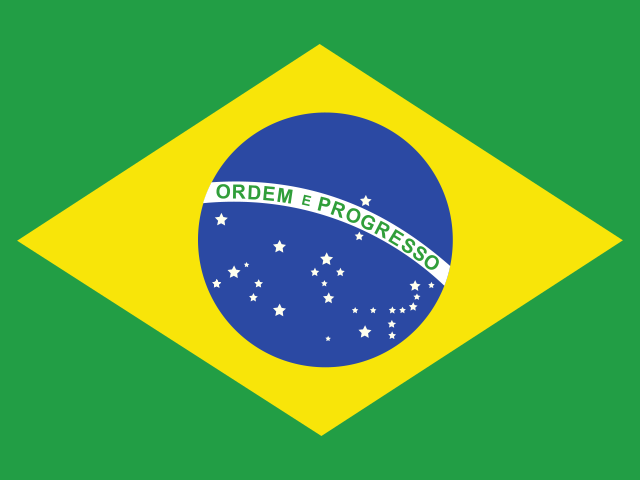
- The stars on the flag are not decoration: they map the sky over Rio de Janeiro on the morning of 15 November 1889, and today there are twenty-seven, one for each state plus the Federal District.
- Brigadeiro, the fudge ball of condensed milk and cocoa rolled in chocolate sprinkles, is named after an air force brigadier whose supporters sold the sweets at fundraising parties in the 1940s.
- The Mata Atlântica along the coast is a rainforest entirely separate from the Amazon, and a large share of its trees, frogs and birds grow nowhere else.
- A cafezinho is a small, very sweet black coffee handed to guests, tradesmen and customers as a matter of course, and turning one down takes some diplomacy.
- The vitória-régia, a giant water lily of the Amazon, spreads leaves more than two metres across with rims that turn up like a tray, and its flowers open white on the first night and turn pink by the second.
- Brasília was raised from empty savannah in under four years and laid out in the shape of an aeroplane, with Lúcio Costa planning the city and Oscar Niemeyer designing its buildings.
- The Amazon carries more water than the next several great rivers combined, and its mouth is so wide that Marajó, the island sitting inside it, is roughly the size of Switzerland.
- Brazilian Portuguese runs on diminutives: a coffee is a cafezinho, a beer is a cervejinha and a quick word is a palavrinha, none of which are really about size.
- Brazil is the only Portuguese-speaking country in the Americas, and more people speak Portuguese here than in the rest of the world put together.
- Moqueca is cooked two ways that people defend fiercely — the Bahian version with red dendê palm oil and coconut milk, and the Espírito Santo version with neither, simmered in a black clay pot.
- Every June the Amazon river town of Parintins fills a purpose-built arena for a contest between two teams, one red and one blue, retelling a folk tale about an ox with enormous floats.
- Pelé scored his thousandth career goal at the Maracanã in 1969 and the country stopped to mark it; he spent almost his entire club career at Santos.
- The golden lion tamarin, a squirrel-sized monkey with a copper mane, lives in the coastal forest of Rio de Janeiro state and nowhere else on Earth.
- Coxinha means little thigh, and the shredded-chicken croquette is moulded into a teardrop meant to resemble a drumstick.
- The pororoca is a tidal bore that shoves upstream against the Amazon around the spring tides; its name comes from Tupi for great roar, and surfers ride single waves for kilometres.
- Capoeira blends fight and dance inside a circle called a roda, and the pace is set by the berimbau, a single-string bow with a gourd for a resonator.
- Brazil nut trees resist farming: they rely on particular large bees for pollination and on a rodent called the agouti to gnaw open the fallen pods, so nearly the whole harvest still comes from wild forest.
- Farofa, manioc flour toasted in butter until it turns sandy, is scattered over almost everything at lunch, and the tin travels to the beach and the barbecue too.
- Festa Junina fills June with bonfires, corn cakes, checked shirts and a square dance called quadrilha, staged as a mock countryside wedding.
Test the four channels.
Understanding Portuguese by ear, reading, recall, and your own mouth. Quick rounds — do them twice.