The five Spanish phrases that do 80% of the work
First time? Do this
- Audio is built in. Tap any phrase to hear it in a native voice — pre-recorded and cached, so it just works offline, no setup. (The voice bar can still pick a phone voice as a backup.)
- Phrases — drilled by situation: the taquería, cantinas, directions, the market. Hit play, then say it back out loud.
- Sounds — nine letters unlock almost everything. Ten minutes here pays off the most.
- Customs — know before you go. The unspoken rules, what politeness actually asks of you, how much English there really is, and where the language shifts between regions. This is where travellers give themselves away.
- Practice — hear / read / recall / speak. Use it on the plane.
Right thing, right moment.
Tap a chip to jump to a scene — or just search. Common holds the go-anywhere basics (hello, thanks, where's the toilet); a few phrases like drinks live under more than one scene.
You can type in either language — both sides are searched.
Common — useful everywhere · greetings · basics · the toilet
Greetings & manners · the social handshake
At the taquería & fonda · ordering & eating
taquería tah-keh-REE-ah — a taco counter, usually standing room and a queue
fonda FOHN-dah — a small family kitchen serving one set lunch a day
Cantinas & nights out · your scene
cantina kahn-TEE-nah — an old-school neighbourhood bar, drinks with free snacks
Mezcal & tequila tasting · agave, done properly
Finding your way · asking directions
Taxis, buses & getting around · rides & fares
Ferries & boat trips · islands & open water
Markets & getting by · everyday
Sea & scenery · quick vocab
Numbers & pesos · prices & ordering
- 16-29 fuse into one word; 31 and up don't. 16 through 29 are single fused words: dieciséis (16), veintidós (22), veintiséis (26). From 31 up the pattern breaks — you say tens + y + ones as three separate words: treinta y dos (32). There is no "veinte y dos" in normal speech; it is always veintidós.
- 31 and up use y between tens and ones. Build any number past twenty-nine as [tens] y [ones]: sesenta y cinco (65), noventa y nueve (99). Y only ever sits between the tens word and the ones digit — never between hundreds and tens.
- cien vs ciento. Exactly 100 alone is cien (cien pesos). The instant anything follows, it becomes ciento: ciento uno (101), ciento veinte (120). 200-900 are separate words (doscientos, trescientos, quinientos...) and don't use cien/ciento at all.
- mil is invariable and never takes "un". 1,000 is just mil, not un mil — unlike millón, which does take un. It doesn't pluralize for multiples: 2,000 is dos mil, 50,000 is cincuenta mil, always mil. Chain hundreds then tens to read a full price: 1,350 is mil trescientos cincuenta.
Same alphabet — and it always plays by the rules.
Spanish says exactly what it spells: five pure vowels that never drift, and stress you can hear. Mexican Spanish lands clearer and a shade slower than Spain's, with no lisped "th" anywhere in it.
Knowing what a letter sounds like isn't the same as being able to make it. These five are where English mouths actually go wrong: what to do, what to stop doing, and a native recording you can slow down and copy.
What your mouth doesA single r between vowels is one flick of the tongue tip — the middle of butter in an American mouth. For rr (and r starting a word), keep the air flowing so the tip flutters: cerrado, and the r of ronda.
The mistakeThe English R for either. pero (but) and perro (dog) differ only by the roll — to Mexican ears they are unrelated words.
What your mouth doesj is an h said further back, with a light rasp, like fogging a mirror hard: jamaica is "hah-MY-kah". In México and other place names, x is that same sound: "MEH-hee-koh".
The mistakeThe English j — "jam-AY-ka" — or reading México with a "ks". The x in the country's own name has been an h-sound for centuries.
What your mouth doesñ is the "ny" of canyon said in one beat: mañana is "mahn-YAH-nah". ll is simply the y of yes: tortilla is "tor-TEE-yah".
The mistakeSaying the l's. "tor-TIL-lah" is the single most common taquería mistake — the double l stopped being an l centuries ago.
What your mouth doesBoth are the same soft b, lips barely meeting: vino is "BEE-noh", veinte is "BAYN-teh". Which letter a word takes is spelling history, not a difference you can hear.
The mistakeThe English v, teeth against lip. It does not exist in Spanish — saying "VEE-noh" carefully is working hard to get it wrong.
What your mouth doesWritten h says nothing at all: hola is "OH-lah". And hold every vowel on one steady note — no drift, no lazy "uh": hermoso is "ehr-MOH-soh", each vowel full.
The mistakeBreathing an h into hola, or letting the o slide into "OH-luh". The h is the one letter you can ignore completely.
- Five vowels, and they never drift. a e i o u are "ah eh ee oh oo" every time, short and clean. English vowels wander; Spanish ones don't.
- Stress has a rule; the accent marks the exception. Words ending in a vowel, n or s stress the second-to-last syllable, everything else the last. The written accent appears exactly where a word breaks that: autobús, estación.
- No lisp anywhere here. c, s and z are all a plain "s": cerveza = "ser-BEH-sa". Save the Castilian "th" for Spain.
- One r or two is a different word. pero is "but", perro is "dog". Tap the single r, roll the double one.
- x is a chameleon in place names. México and Oaxaca take an "h", Xochimilco takes an "s", and Maya names like Xcaret take a "sh". Local habit beats any rule.
The politeness is built into the grammar
Once you can read Mexican Spanish aloud you can be understood almost anywhere in the country. What takes longer is the layer on top — a set of habits that are not in the textbook because they are not rules exactly, and that make the difference between correct Spanish and Spanish that sounds like it belongs here.
The little -le stuck on the end of verbs is not a mistake. Ándale, órale, híjole, córrele, échale, hazle — the ending has drifted loose from its grammar and become pure emphasis, and Mexicans use it constantly, for encouragement, agreement, surprise and hurry, sometimes all four in one conversation. You do not have to produce it. You do have to stop trying to parse it as a pronoun.
Diminutives are politeness, not size. -ito and -ita get attached to almost anything to take the hard edge off it: un momentito, cerquita, tantito, ahí nomás, despacito. A cafecito is not a small coffee, it is a friendly coffee. Stripping the diminutives out of your Spanish leaves sentences that are grammatically perfect and faintly abrupt.
Mexico has no vosotros at all. Every you all, however casual, is ustedes with third-person plural verbs, which is one whole conjugation you never have to learn here. In exchange, the country asks for something Spain does not: mande. Where an English speaker says what? and a Spaniard says ¿qué?, the traditional Mexican response to being addressed — especially by someone older — is ¿mande?. It is fading among younger city speakers and still standard almost everywhere else, and a blunt ¿qué? to an older person lands badly.
And a direct no is rare. A shopkeeper who does not have the thing, a driver who cannot do the trip, an office that will not solve your problem — all of them are more likely to produce déjeme ver, yo le aviso, vamos a ver or a warm and unspecific sí. This is courtesy rather than evasion: a flat refusal is felt as rudeness, so the refusal gets wrapped. Listen for whether anything concrete was actually promised.
The clearest Spanish there is, until the consonants stack up
Mexican Spanish is the friendliest major variety for a beginner's ear, and that is not a compliment about the accent so much as a description of the mechanics. There is no Castilian th anywhere in it, the vowels stay pure and short, consonants at the ends of syllables actually get pronounced instead of being softened away, and the pace is a shade steadier than Spain's. There is a reason so much of the Spanish-language dubbing that plays across the Americas is recorded in Mexico City: it is the version most people can follow.
Two things will still catch an English mouth out. The first is that Mexican Spanish squeezes its unstressed vowels hard when they sit next to an s, so pues flattens to something like ps, entonces to entons, and muchas gracias loses most of its middle. Nothing is being slurred; the consonants are being kept and the vowels spent. The second is Nahuatl. The language of the Aztec empire left Mexican Spanish a set of consonant clusters that exist nowhere in English — the tl that ends Popocatépetl and begins tlacoyo, the tz of quetzal, the x that behaves differently in almost every place name it appears in. Say the tl as one sound with the tongue already on the ridge behind your teeth, and do not try to insert a vowel to rescue it.
The rules nobody prints on the menu.
Your Spanish rarely outs you. These do. Read once, and you'll move differently.
Greet first, always
Walking into a shop, a taxi, a waiting room or even a lift without buenos días (BWEH-nohs DEE-ahs) reads as cold. Use usted (oo-STED) with anyone older than you or anyone serving you.
Say ¡Provecho! on your way out
Passing strangers mid-meal as you leave a restaurant, say provecho (proh-BEH-choh) — a small, universal courtesy. To call a waiter, catch their eye and say joven (HOH-behn) or señor (seh-NYOR); never snap or wave.
Sip the mezcal, don't shoot it
The saying goes para todo mal, mezcal; para todo bien, también (PAH-rah TOH-doh mahl, mehs-KAHL; PAH-rah TOH-doh byehn, tahm-BYEHN). Kiss the glass, take small sips, nibble orange with sal de gusano (sahl deh goo-SAH-noh). Throwing back good agave marks you instantly.
Tipping: 10–15%, in cash
Leave 10–15% at restaurants, after checking the bill for propina incluida (proh-PEE-nah een-kloo-EE-dah). Also tip the supermarket bagger (often an unpaid pensioner or kid), the petrol attendant, and hotel staff — in pesos.
"Ahorita" bends time
Ahorita (ah-oh-REE-tah) looks like "right now" but means anything from five minutes to never — it's a softener, not a schedule. A gentle Mexican "no" often sounds like a yes; read the warmth, not the words.
The clock runs late
La comida (lah koh-MEE-dah), the big meal, runs 2–4pm; la cena (lah SEH-nah) is lighter and after 8 or 9pm. Turn up for dinner at six and you'll have the place to yourself, which is not the goal.
Take a sitio or an app, not a street cab
In Mexico City especially, use Uber or DiDi, or a sitio (SEE-tyoh) taxi called by your hotel or restaurant, rather than flagging one down. Carry small notes — few drivers can break a 500.
Don't drink the tap water
Stick to agua embotellada (AH-gwah em-boh-teh-YAH-dah) or the purified garrafón (gah-rrah-FOHN) water hotels refill. Ice in restaurants and established stalls is factory-made and generally fine; when in doubt, ask.
Don't call Cinco de Mayo Independence Day
May 5 marks the Battle of Puebla and is a far bigger deal in the United States than in most of Mexico. Independence is el 16 de septiembre (ehl dyeh-see-SAYS deh sep-TYEHM-breh), celebrated the night before with El Grito (ehl GREE-toh).
Don't treat Día de Muertos as Halloween
November 1–2 is a warm family reunion with the dead — marigolds, photographs and favourite foods on an ofrenda (oh-FREN-dah). It isn't spooky, and a cemetery is not a photo backdrop; ask before you shoot.
The plates and glasses worth going out of your way for — each with the name as you'd say it out loud.
Six more things worth knowing before you land
The bill arrives when you send for it. Nobody is neglecting you: bringing the account unasked would be pushing you out of your chair. Catch the waiter's eye and either say la cuenta, por favor or make the small signature-in-the-air gesture everyone here understands. In most restaurants the card terminal then comes to the table and never leaves it — your card is not carried away.
Carry small notes and expect the change question. Taxis, market stalls, taquerías and small shops frequently cannot break a large note, and the polite request ¿tiene cambio? or ¿tiene feria? comes before the sale rather than after it. Break big notes in supermarkets and chain stores, where they are no trouble, and keep coins for the people who bag your groceries — a job often done for tips alone.
Order tacos the way tacos are ordered. You ask for a number and a filling — dos de pastor — and the follow-up question is ¿con todo?, which means with onion and coriander. If you do not want them, sin cebolla or sin cilantro, said before the taco is built rather than after. The salsas on the counter are yours to add and are not graded for visitors: ¿pica? — is it hot — will nearly always be answered with no, poquito, and that answer is unreliable in one direction only.
Mexico City is at 2,240 metres and it will find you out. That is higher than most European ski resorts. For the first day or two, alcohol hits harder, stairs are longer than they look, and dehydration arrives quietly. Puebla, Toluca and San Cristóbal are higher still. Drink water, take the first evening gently, and do not read the altitude as a hangover.
If a loud two-tone alarm goes off in the street, follow the locals out. Mexico City's seismic alert broadcasts through speakers across the city and gives roughly a minute's warning before shaking arrives from the coast. People walk out calmly to the marked assembly points; there is also a national drill each year on 19 September, when the alarm sounds and nothing is happening at all. Either way, do what the room does.
For anything minor, the pharmacy is the doctor. Many pharmacies have a consultorio attached — a small consulting room with a doctor in it, no appointment, a fee of a few dollars' equivalent in pesos, and a prescription filled at the counter next door. It is how a very large number of Mexicans get routine medical care, it is entirely legitimate, and it will solve a stomach upset or an infected cut in half an hour.
Spanish is not the only language of Mexico, legally or otherwise
Mexico has no official language at federal level. What it has instead is a 2003 law that recognises sixty-eight indigenous language groups — several hundred distinct local varieties between them — as national languages, with the same legal standing as Spanish. Over a million people speak Nahuatl. Several hundred thousand speak Yucatec Maya, and in parts of Yucatán and Quintana Roo you will hear it in markets and on buses. Zapotec, Mixtec, Otomí, Tzeltal and Tzotzil each have populations larger than some European countries' minority languages. Almost all of those speakers also speak Spanish, so this is not a barrier for a traveller; it is context for why Mexican Spanish sounds and behaves the way it does.
It is also why so much of the vocabulary has no relative in Spain. Elote, esquite, tianguis, itacate, popote, papalote, cuate, mezcal, chipotle — all Nahuatl, all everyday, and none of them will be understood in Madrid. English took the same road and does not notice: chocolate, tomato, avocado, chilli and coyote all came out of Nahuatl by way of Spanish.
On English: it is genuinely everywhere in Cancún, Los Cabos, Playa del Carmen and the border cities, common in business districts of Mexico City and Monterrey, and thin the moment you step outside those. A market in Oaxaca, a second-class bus station, a village restaurant, a pharmacy in a colonial town — those are the places where a hundred words of Spanish stops being a party trick and starts being the difference between the day working and not.
Usted goes further in Mexico than anywhere else
Mexico is the formal end of the Spanish-speaking world, and the gap between it and Spain surprises travellers who learned the language in Europe. Usted is used with anyone older, anyone serving you, anyone in an office, anyone you have just met, and often permanently with a friend's parents or an in-law. It is not stiff and it does not create distance; it is simply the neutral setting. Tú is for friends, peers you have been introduced to properly, and children. Over-formality costs you nothing here. Under-formality is noticed.
Address is done by role rather than by name. A waiter of any age is joven; an older man is señor, an older woman señora; a tradesman, a driver or anyone doing something skilful is maestro; jefe works for whoever is in charge of the thing in front of you. Calling out joven across a restaurant is the correct way to get service — waving, clicking or shouting garçon-style is not.
The most Mexican thing in the language is the way a request gets asked. ¿Me regalas una servilleta? literally means will you gift me a napkin, and it is the ordinary, everyday way to ask for something small in a shop or a market. ¿Me da chance? asks to be let past or let in. ¿Sería tan amable? is the polished version. Con permiso is what you say before crossing in front of someone, leaving a table, or entering a room; perdón is for after you have already bumped into them. The two are not interchangeable and Mexicans notice which one you reach for.
Goodbyes carry a blessing more often than not. Que le vaya bien, que tenga buen día, que Dios lo bendiga from an older person — these are said sincerely and to strangers, and the expected reply is the same wish returned: igualmente. Answering a warm Mexican farewell with a flat adiós is the conversational equivalent of hanging up.
A norteño and a yucateco do not sound alike
Mexico City Spanish — chilango, a word its speakers use about themselves with varying affection — is the version that dubbing, television and this kit are built on. It has a distinctive rising-falling melody at the end of phrases, the vowel-squeezing described above, and the country's densest slang: ¿qué onda?, güey, chido, no manches, fresa, neta. Some of it is very informal, and güey in particular is friendship between peers and an insult from a stranger.
The north — Monterrey, Chihuahua, Sonora, Tijuana — is faster, flatter and blunter, with vocabulary that has crossed the border in both directions: troca for a pickup, morra for a young woman, bironga for a beer. Southern Mexicans tease the north for sounding abrupt; northerners tease the centre for sounding like a soap opera. Both do it fondly.
Yucatán is the real outlier. Centuries of bilingualism with Yucatec Maya have left the Spanish there with its own rhythm — clipped, with a hard little catch between words, and final n turning towards m — plus a stock of Maya words used by people who do not speak Maya at all. It is the one part of the country where a Mexican from elsewhere will tell you they need a moment to tune in. The coasts, Veracruz above all, go the other way and sound Caribbean, dropping the s at the ends of syllables exactly as Cuba does.
The vocabulary map is worth a glance before you shop. A drinking straw is a popote here and has a different name in nearly every other Spanish-speaking country. A bus between cities is a camión, which everywhere else means a lorry. A swimming pool is an alberca, not a piscina. A sandwich in a bread roll is a torta in most of the country and a lonche in parts of the north and west. Work is chamba. And a Spaniard's perfectly innocent coger is vulgar here — use tomar for taking a taxi or a bus.
Mexico, in sixty small pieces
Everything the card at the top of Start draws from — one a day, and here is the whole file. Read it on the plane.
- A mariachi group is built around violins, trumpets, a guitar, the deep guitarrón and the small high-strung vihuela, and the tradition grew out of Jalisco.
- The classic piñata is a seven-pointed star, its points once explained as the seven deadly sins, which is why you are blindfolded and spun around before you swing.
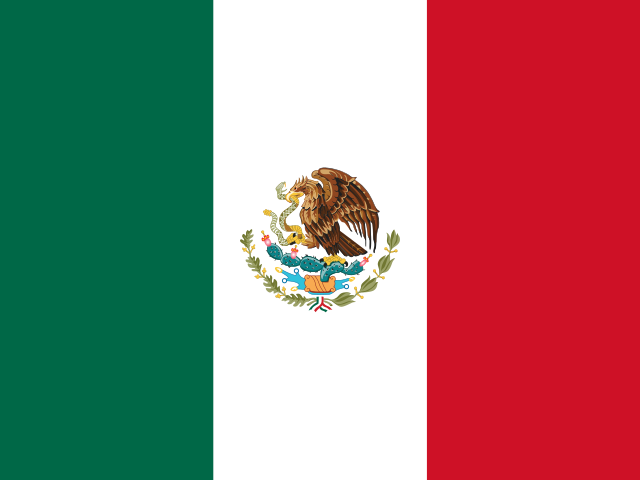
- The eagle on the flag, perched on a cactus with a snake in its beak, is the sign the Mexica were told to watch for; where they saw it they founded Tenochtitlán, traditionally in 1325.
- For the nine nights before Christmas neighbours walk from house to house singing at each door and being turned away, until one house finally opens and the party begins: las posadas.
- Chilli belongs in the sweet shop as well: tamarind candies and lollipops come dusted with chilli and salt, and the sticky sauce called chamoy is poured straight over cut fruit.
- Passing a stranger's table in a restaurant you say provecho, roughly enjoy your meal, and diners will say it back to you as you get up to leave.
- The x in México is pronounced like an h, a survival of older Spanish spelling that also explains Oaxaca, Xalapa and, at one remove, Texas.
- Maize was domesticated in the Balsas river valley from a scrubby grass called teosinte thousands of years ago, and every ear of corn on earth descends from that work.
- English quietly borrowed chocolate, tomato, coyote, chilli and ocelot from Nahuatl, the language of the Aztec empire, usually by way of Spanish.
- Mesoamericans mixed latex with morning glory sap to make solid bouncing rubber balls thousands of years before vulcanisation, and played a ball game with them on stone courts.
- The Barrancas del Cobre in Chihuahua form a system of canyons whose deepest gorges cut further down than the Grand Canyon, crossed by a passenger railway.
- At the equinoxes the stepped corner of the great pyramid at Chichén Itzá throws a shadow down the balustrade that reads as a snake descending toward the carved head at the base.
- Cacao beans worked as money across Mesoamerica: goods were priced in beans, and the practice outlasted the arrival of coins by a long stretch.
- Grasshoppers toasted with lime, garlic and chilli are sold by the scoop in Oaxaca's markets under the name chapulines, eaten by the handful or folded into a taco.
- Cancún and Cozumel are Maya names, usually explained as nest of snakes and island of the swallows, and hundreds of thousands of people still speak Yucatec Maya on the peninsula.
- The xoloitzcuintle is a hairless dog whose name joins Xólotl, an Aztec god, with itzcuintli, the Nahuatl word for dog; the breed has been kept here for thousands of years and its bare skin is famously warm to the touch.
- On Día de Muertos families build an ofrenda with photographs, the food the dead liked best and marigolds whose scent is said to guide them home; it is a welcome, not a mourning.
- Charrería, the horsemanship of the working ranch turned into competition, is the national sport, and a charreada is judged on style as much as on skill.
- Café de olla is brewed in an unglazed clay pot with a cone of raw cane sugar called piloncillo and a stick of canela, and the clay itself is counted as part of the flavour.
- When a Mexican mishears you, the reply is often mande, literally command me, an old courtesy that visiting Spanish speakers find startlingly formal.
- Mole poblano folds chillies, spices, seeds and a little chocolate into one dark sauce; the chocolate is there for depth, not sweetness, and families guard their own proportions.
- The first printing press in the Americas was set up in Mexico City in 1539, and books were coming off it a full century before any were printed in what is now the United States.
- Mezcal's smokiness is not an additive: the agave hearts are roasted for days in a pit lined with hot stones and burning wood before they are crushed and fermented.
- The Aztecs did not build Teotihuacán. They found it already ancient and empty and gave it the name, which means roughly the place where the gods were born.
- Modern chewing gum began as chicle, the sap of the chicozapote tree tapped in the Yucatán forests, which a New York inventor turned into a product in the nineteenth century.
- In the ritual of the voladores, four men tied by the ankles launch backwards off a tall pole and spin slowly to the ground while a fifth stands on top playing flute and drum.
- The Sótano de las Golondrinas in San Luis Potosí is a cave shaft with a free drop of more than 300 metres, and at dawn birds spiral up out of it in a slow column.
- Vanilla comes from an orchid native to Mexico's Gulf coast, grown and cured by the Totonac people around Papantla in Veracruz long before it ever reached Europe.
- Gray whales swim from the Arctic to shallow lagoons on the Pacific side of Baja California to calve, and in some of them the mothers bring their calves right up to the boats.
- Guacamole preserves the Nahuatl word mōlli, a sauce: ahuacamōlli was avocado sauce centuries before anyone spelled it in Spanish.
- Chiles en nogada appears in late summer, when walnuts and pomegranates come in: a roasted poblano chilli under white walnut cream, scattered with red seeds and green parsley.
- A kite is a papalote, from the Nahuatl papalotl, butterfly, which is roughly what one looks like from the ground.
- Mexico City stands on the drained bed of Lake Texcoco, which is why its colonial churches lean at visible angles and the ground beneath them keeps settling.
- Talavera pottery is still thrown and hand-painted with a tin glaze in a limited palette, and only workshops in and around Puebla are allowed to sell it under that name.
- The mint in Mexico City has been striking coins since 1535; its silver pesos circulated as far as China, and one common explanation of the dollar sign's shape traces back to them.
- Nachos were improvised in 1943 in Piedras Negras, Coahuila, when a maître d' named Ignacio Anaya threw together tortilla chips, cheese and jalapeños for late guests; his friends called him Nacho.
- The Tropic of Cancer crosses the middle of the country, which is why the south is tropical forest and much of the north is desert.
- Alebrijes are painted creatures with the wings of one animal and the tail of another, dreamed up in the twentieth century by the Mexico City papier-mâché artisan Pedro Linares.
- Oaxaca comes from the Nahuatl Huāxyacac, about at the tip of the huaje trees, and the pods of that tree are still eaten in the region.
- Tacos al pastor are carved off a vertical spit called a trompo, a technique Lebanese immigrants brought to Puebla, and the pork is finished with a slice of pineapple flicked onto the tortilla.
- The Yucatán Peninsula has almost no surface rivers; rain sinks straight through the limestone into an underground network, and a cenote is a place where the roof has collapsed.
- Ahorita is the diminutive of ahora, meaning now, and can land anywhere between in a second, in an hour, and never; the tone does all the work.
- Street corn is served as elote, the whole cob painted with mayonnaise, crumbled cotija cheese, chilli powder and lime, or sliced off into a cup and called esquites.
- Maya mathematicians wrote a zero, drawn as a shell, and kept a calendar that counted days in one unbroken run from a fixed starting point.
- In lucha libre the mask is the wrestler's identity, and the highest stake a match can carry is máscara contra cabellera: the loser is either unmasked or has his head shaved.
- The Gulf of California, the narrow sea between the mainland and Baja California, is also known as the Sea of Cortés, and Jacques Cousteau called it the aquarium of the world.
- Monarch butterflies from Canada and the United States pass the winter clustered on oyamel firs in the mountains of Michoacán and the State of Mexico, thick enough to bend the branches.
- The stadium wave spread around the world from the 1986 World Cup held here, which is why much of the planet still calls it the Mexican wave.
- Popocatépetl means smoking mountain in Nahuatl and Iztaccíhuatl means white woman; the two volcanoes stand side by side southeast of the capital.
- Sixty-eight indigenous languages are officially recognised alongside Spanish, among them Nahuatl, Yucatec Maya, Mixtec, Zapotec and Otomí.
- Cochinita pibil is pork rubbed with achiote and sour orange, wrapped in banana leaves and cooked in an earth oven called a píib, the Maya word that gives the dish its name.
- A spirit may only be called tequila if it is distilled from blue agave grown in a legally defined region centred on the town of Tequila in Jalisco.
- The country's name comes from Mēxihco, the heartland of the Mexica people, whose island city Tenochtitlán stood exactly where Mexico City stands today.
- Pico de Orizaba, called Citlaltépetl or star mountain in Nahuatl, reaches 5,636 metres and carries glaciers despite sitting well inside the tropics.
- The engineer Guillermo González Camarena patented a colour television system in 1940, while still in his twenties, and later broadcast in colour from Mexico City.
- The axolotl, a salamander that keeps its feathery gills for life and regrows lost limbs, lives wild only in the canals around Xochimilco in Mexico City.
- Whoever finds the little figure baked into the rosca de reyes on 6 January owes everyone tamales on 2 February, and the debt is collected.
- Every station on the Mexico City metro carries its own pictogram, a grasshopper or a cannon or an aqueduct, so the whole network can be navigated without reading a word.
- Maize is simmered in mineral lime water before it can become a tortilla, a Mesoamerican process called nixtamalización that softens the grain and unlocks nutrients the body otherwise cannot absorb.
- More species of cactus grow in Mexico than in any other country, and a great many of them grow nowhere else on earth.
Test the four channels.
Understanding Spanish by ear, reading, recall, and your own mouth. Quick rounds — do them twice.