The five Portuguese phrases that do 80% of the work
First time? Do this
- Audio is built in. Tap any phrase to hear it in a native voice — pre-recorded and cached, so it just works offline, no setup. (The voice bar can still pick a phone voice as a backup.)
- Phrases — drilled by situation: the tasca, bars, directions, the ferry. Hit play, then say it back out loud.
- Sounds — nine letters unlock almost everything. Ten minutes here pays off the most.
- Customs — know before you go. The unspoken rules, what politeness actually asks of you, how much English there really is, and where the language shifts between regions. This is where travellers give themselves away.
- Practice — hear / read / recall / speak. Use it on the plane.
Right thing, right moment.
Tap a chip to jump to a scene — or just search. Common holds the go-anywhere basics (hello, thanks, where's the toilet); a few phrases like drinks live under more than one scene.
You can type in either language — both sides are searched.
Common — useful everywhere · greetings · basics · the toilet
Greetings & manners · the social handshake
At the tasca (restaurant) · ordering & dining
tasca TAHSH-kah — a tiny neighbourhood tavern, cheap plates and jug wine
Bars & nights out · your scene
Port & wine tasting · tasting & buying
Finding your way · asking directions
Taxis & getting around · rides & fares
On the water · ferries & boat trips
Shops & getting by · everyday
Sea & scenery · quick vocab
Numbers 1–100 · prices & ordering
- Only 16-19 glue; from 20 up, e connects every piece. Unlike Spanish, Portuguese doesn't fuse 21-29 into one word. Only 16-19 are glued onto dez. From 20 up, insert e between every level: vinte e um (21), cento e vinte (120), duzentos e quarenta e um (241) — e can appear twice in one number.
- cem vs cento. Exactly 100 alone is cem (cem euros). As soon as anything follows, it becomes cento: cento e um (101). 200-900 are their own words (duzentos, trezentos, quinhentos...) and never use cem/cento.
- mil stays singular; milhão pluralizes. Mil never changes for multiples: dois mil (2,000), cinquenta mil (50,000) — always mil. Milhão does pluralize: um milhão, dois milhões. Chain place values in descending order: 1,350 is mil, trezentos e cinquenta.
Same letters — but Portuguese eats them.
European Portuguese swallows its unstressed vowels and turns every final s into "sh", which is why it can sound almost Slavic to a first-time ear. Learn seven or eight habits and the writing snaps back into place.
Knowing what a letter sounds like isn't the same as being able to make it. These five are where English mouths actually go wrong: what to do, what to stop doing, and a native recording you can slow down and copy.
What your mouth doesAt the end of a word — and before most consonants — s is "sh": dois is "doysh", três is "tresh". This soft shushing is the sound of the whole language; lean into it.
The mistakeA crisp English s. "doyss" instead of "doysh" is the fastest way to mark yourself out — the shush is not sloppiness, it is the rule.
What your mouth doesSay "ow" and let the air escape through your nose at the same time, closing nothing — pão is "powng" with the g dissolved before it lands. Once you can do it, you will hear it everywhere.
The mistakeA plain "ow" — pão (bread) collapses into pau (a stick). The nose is not optional; it is the letter.
What your mouth doesAt the start of a word, or doubled, r is a soft rasp from the back of the throat — the gargling place: rua. Between vowels it is the opposite: one light flick of the tongue tip, the middle of butter in an American mouth: Obrigado.
The mistakeThe English R for either, or rolling the throaty one on the tip. Two different r's, neither of them the one English taught you.
What your mouth doesSay both halves at the same instant. For lh, press the flat of your tongue to the roof of your mouth and release an L and a Y together — bacalhau is "bah-kahl-YOW". nh is the same trick with N, the "ny" of canyon: vinho is "VEEN-yoo".
The mistakeSplitting them into two beats — "bah-kal-HOW", "VIN-ho". The h is not a sound; it is the signal that the l or n has gone soft.
What your mouth doesAn unstressed e all but disappears: desculpe comes out "dish-KOOLP", and the Se of Se faz favor is barely there at all. The language sounds compressed because it is — let those little vowels go and the rhythm arrives on its own.
The mistakeGiving every written vowel a full beat. It doesn't just sound foreign — stretching the word out can actually make you harder to understand.
- Unstressed vowels get swallowed. Portugal compresses everything that isn't stressed — telefone collapses toward "tlf-ÓN". Find the stressed syllable and let the rest blur.
- s changes with its neighbours. At the end of a word it's "sh" (dois = "doysh"); between two vowels it's "z" (casa = "KA-za").
- Nasal vowels are everywhere. A tilde (ã õ) or any vowel before m or n goes through the nose: não, bom, sim. A final m is never a real m.
- Stress has a rule; the accent marks the exception. Words ending in a vowel, m or s stress the second-to-last syllable; those ending in r, l or z stress the last. Anything else prints an accent: café, açúcar.
- Portugal and Brazil part ways here. Portugal clips the vowels and hisses its final s; Brazil opens the vowels right up. Both understand you — you'll just sound like you learned in the other one.
A grammar with one feature no other language has
Once the sounds stop fighting you, European Portuguese is a well-behaved Romance language with two genders, a familiar set of tenses, and a couple of structures worth meeting before you meet them in the wild.
The first is that polite Portuguese avoids the word you altogether. Rather than choose a pronoun, it addresses you in the third person, by title or by name: o senhor quer…?, a senhora precisa de…?, o João já jantou? — or simply drops the subject and leaves the verb to carry it, como está?. This is a genuinely different way of being polite from the one Spanish, French or Italian teach, and it is the single most useful thing on this page.
The second is the personal infinitive, which Portuguese has and no other major language does: an infinitive that takes endings for who is doing it. É melhor esperarmos — it is better for us to wait; antes de saíres — before you leave. You can travel the whole country without producing one, and you will hear them constantly, so it is worth being able to recognise a verb that looks like an infinitive with something stuck on the end.
Then there is ficar, the workhorse of the language. It means to stay, to become, to be located, to end up, to keep, and to be left in a state — onde fica a estação? for where is the station, fiquei doente for I got ill, fica bem for it suits you. Learning one verb this flexible is worth ten nouns.
And the false friends aimed at Spanish speakers are the ones to watch. Esquisito means strange. Espantoso means amazing. Largo is a small square in a town rather than something long. Constipado is a head cold. And propina, which is a tip in Spanish, is a university tuition fee in Portugal — the tip you leave on a table is a gorjeta.
Why it sounds nothing like it looks
European Portuguese is the hardest of the Romance languages to hear, and travellers who arrive with Spanish or French are the most surprised by it. On paper it is transparently a sister of both. Out loud it is stress-timed and ruthless: the stressed syllable takes almost all of the energy in a word and everything around it is squeezed towards silence, so telefone collapses towards tlfón and está arrives as tá. Add the hiss of every final s and the density of nasal vowels, and the result is a language that a first-time listener regularly guesses is Slavic. That is a compliment to how far it has travelled from the spelling, and a warning about what your ear has to do.
The way in is to stop listening for syllables and start listening for the stressed one. Find it, and the collapsed vowels around it stop being missing sounds and start being scaffolding. It is also worth knowing which direction the comprehension runs: Portuguese speakers understand Brazilian Portuguese effortlessly, because it is on television and in the music all day and it pronounces everything. The reverse is much harder. If you learned your Portuguese for Brazil, expect Lisbon to cost you a week of ear.
The rules nobody prints on the menu.
Your Portuguese rarely outs you. These do. Read once, and you'll move differently.
Greet the room before you ask anything
Walking into a bakery, lift, waiting room or small shop without a bom dia (bong DEE-ah) or boa tarde (BOH-ah TARD) reads as cold. It's aimed at everyone present, not just the person serving you.
Obrigado changes with you, not with them
Men say obrigado (oh-bree-GAH-doo), women say obrigada (oh-bree-GAH-dah) — always, no matter who is being thanked. It's the single most common tourist slip and locals notice instantly when you get it right.
The bread and olives are not a gift
The couvert (koo-VEHR) that lands unordered — bread, olives, cheese, sardine paste — is billed per item you open. Waving it away with a smile is completely normal and not remotely rude.
Drink your coffee standing at the counter
Ask for um café (oong kah-FEH) and you get a small strong espresso, which in Lisbon is also called uma bica (OO-mah BEE-kah). It costs about a euro at the bar, more at a table, and is drunk in two minutes.
Tipping is light and cash
Service isn't included but nobody expects American percentages. Round up a coffee or a beer, leave 5–10% for a proper meal you enjoyed, and hand it over in coins or notes rather than on the card machine.
Don't treat it as Spain-adjacent
Speaking Spanish, comparing the food to tapas, or calling the language a Spanish dialect all land badly — the two countries have been separate for the better part of a thousand years. English is far more welcome than Spanish.
Saudade is the word that explains the country
Saudade (sow-DAHD) is a warm ache for something or someone absent — a place, a time, a person who may never come back. It's the engine of fado and of the Portuguese temperament: melancholy, but affectionate about it.
Don't talk over fado
When the lights drop and the singer starts, conversation stops — glasses down, no flash photos, no walking to the toilet mid-song. Applaud at the end, and someone will pour you more wine.
Meals run late by northern standards
Lunch is roughly 1–3pm and dinner rarely starts before 8pm, often 9. A restaurant with a full dining room at 6:30 is a restaurant built for tourists.
Two kisses, right cheek first
Women greeting women, and men greeting women, do two light cheek kisses starting on your right. Men shake hands. In shops and restaurants a nod and boa tarde (BOH-ah TARD) is all that's wanted.
The plates and glasses worth going out of your way for — each with the name as you'd say it out loud.
Six practical things to know first
Coffee has a vocabulary and it is short. Um café is an espresso and is what nearly everyone drinks. Uma meia de leite is half coffee, half milk, in a cup; um galão is the same thing in a tall glass and mostly milk; um abatanado is a longer black coffee, the closest thing to what an American means by coffee; um pingado is an espresso with a drop of milk. There is no useful word for a takeaway bucket of it, because that is not what coffee is for here.
Lunch is the cheap meal and it has its own menu. Look for prato do dia or menu de almoço chalked outside on a weekday: a main course, often soup, bread, a drink and sometimes coffee at a fixed price. It is served at lunch and rarely in the evening, and it is where ordinary Portuguese food is eaten by ordinary Portuguese people.
Multibanco does everything, and cash still matters. The national ATM network is a genuine wonder — it will sell you train and concert tickets, top up a phone, pay a utility bill and settle a tax notice, in English, from any machine. At the other end of the scale, plenty of small cafés, village restaurants and market stalls remain cash-only or have a card minimum, so keep notes on you.
Motorway tolls are the classic rental-car trap. Several Portuguese motorways have no toll booths at all — a gantry photographs the plate and expects the account to be settled electronically. A foreign-registered car with no transponder can accumulate charges the driver never sees, arriving months later as fines through the rental company. Take the toll device the rental desk offers, or plan a route on the untolled national roads, which are slower and much prettier.
The pavement is beautiful and it is slippery. Portuguese calçada — hand-laid limestone cobbles polished by decades of feet — turns treacherous in rain, and Lisbon and Porto are both built on hills. Smooth-soled shoes are a genuinely bad idea in this country, more so than in any other in Europe.
The custard tart is finished at the table. A pastel de nata is served warm and the cinnamon and icing sugar are on the counter for you to add yourself — not doing it is a small waste. The ones sold in Belém as pastéis de Belém are a specific product from one 1837 shop working to a monastery recipe, which is why they are a different word rather than a better tart.
A small country at the centre of a very large language
Portuguese is spoken by something over 250 million people across nine countries on four continents, and Portugal is much the smallest of them. That relationship shapes how the language is treated here. Brazilian Portuguese is everywhere on Portuguese television and radio; European Portuguese is what the schools, the state and the street use; and the differences between them are a live and slightly touchy subject rather than a technicality. Portugal also has a second official language, which almost no visitor has heard of: Mirandese, spoken in a handful of villages in the far northeast around Miranda do Douro, recognised by law since 1999, and descended not from Portuguese but from the Asturian-Leonese of the medieval kingdoms next door.
On English, Portugal is genuinely and unusually good — near the top of Europe in every survey, with the usual explanation being that foreign film and television here are subtitled rather than dubbed, so the country grew up reading along. In Lisbon, Porto and the Algarve you could conduct an entire trip in English without difficulty.
Which is exactly the argument for not doing it. Because English works so well here, almost no visitor tries, and the effect of arriving with fifty words of Portuguese is disproportionate — in a village café, a market, a family restaurant off the tourist grid, or with an older person who does not speak English and is used to being talked past. This is a country where the effort is noticed precisely because so few people make it.
The trap is the word that looks polite
Portugal draws the formality line harder than Brazil does, and in the opposite place from where a Brazilian-taught speaker expects. Tu is the familiar form, used with friends, family, children and colleagues you know. Formality is carried by o senhor and a senhora, or by the person's name or title used in the third person.
And você, which is the neutral everyday word in Brazil, is a trap here. In European Portuguese it sits in an awkward middle: from a stranger it can sound distancing or even condescending, particularly to someone older, and it is not the safe default a Brazilian phrasebook implies. If in doubt, use no pronoun at all. Como está?, quer um café?, pode ajudar-me? — the bare verb is polite, correct and completely invisible, which is precisely why Portuguese speakers use it constantly.
Titles matter more here than in most of western Europe. Senhor doutor is used for anyone with a degree, not only physicians; senhor engenheiro, senhor arquitecto and senhora professora are ordinary forms of address rather than jokes. You are unlikely to need to produce them, but you will hear them, and hearing them as normal rather than obsequious tells you something true about the country.
For requests, faz favor and se faz favor do more work than por favor, and they double as the way to get a waiter's attention — said quietly, with a raised hand, never with a click of the fingers. Desculpe begins an interruption; com licença gets you past someone. And pois and então are the sounds of a Portuguese conversation running, filling the space that well and so fill in English.
The north and the south do not say the same words
Portugal is small enough to drive end to end in a day and still splits cleanly. The north — Minho, Trás-os-Montes, and Porto itself — is the most distinctive: many northern speakers do not separate v from b, so vinho can arrive sounding like binho, and the vowels are rounder and the delivery quicker than in Lisbon. It is a source of steady, affectionate mockery from the capital and steady, affectionate contempt in return.
The Alentejo, the great plain south of the Tagus, slows everything down and lengthens its vowels, and has its own polyphonic singing tradition to go with it. The Algarve clips. The Azores — São Miguel especially — have a vowel system so distinctive that mainland Portuguese sometimes say it sounds French, and Madeira has its own accent and vocabulary again.
The vocabulary split you will meet fastest is the one at the bar. A small draught beer is a fino in Porto and the north and an imperial in Lisbon and the south — order the wrong one and you will be understood and quietly placed. An espresso is a bica in Lisbon, a cimbalino to older speakers in Porto, and just um café anywhere in the country.
The other split is not regional but national, and worth stating plainly: European and Brazilian Portuguese differ in pronunciation, in vocabulary, in the pronoun above and in some grammar, and Portugal is not indifferent about which one a visitor has learned. Neither is wrong and everyone understands both. But asking for a trem rather than a comboio, or an ônibus rather than an autocarro, tells a Portuguese ear exactly where your Portuguese came from.
Portugal, in sixty small pieces
Everything the card at the top of Start draws from — one a day, and here is the whole file. Read it on the plane.
- Grilled sardines are a June ritual rather than an everyday dish — whole fish over charcoal, eaten off a slice of bread that soaks up the oil, in streets strung with paper garlands.
- Around Alqueva in the Alentejo, a plain of cork oaks and one enormous reservoir, the night sky is dark enough that the area is managed as a starlight reserve with the lighting written into local rules.
- Vasco da Gama's ships reached India by sea in 1498, sailing from Lisbon around the southern tip of Africa and opening a route Europe had until then only been able to imagine.
- Caldo verde is potato puréed smooth with finely shredded kale, a slice of smoky chouriço and a thread of olive oil — Minho food that turns up at weddings and street parties all over the country.
- Madeira simply means wood, a name given for the forest that once covered the island, and a remnant of that ancient laurel wood, the laurissilva, still clings to the northern slopes.
- Order a galão and you get espresso topped with hot milk in a tall glass; ask for um café and you get a short dark espresso, which in Lisbon plenty of people still call a bica.
- The waves at Nazaré owe their size to a submarine canyon several kilometres deep that runs almost to the shore and funnels open Atlantic swell onto one point of sand.
- Manueline is Portugal's own style of architecture: stone carved into ropes, knots, anchors, coral and armillary spheres, seen at its best on the Torre de Belém and the Jerónimos cloister.
- Cork is stripped off the sobreiro, the cork oak, in slabs cut by hand once every nine years; the tree is protected by law, carries on growing, and gets the year of its last harvest painted on the trunk.
- Lisbon's Baixa was rebuilt in the 18th century on one strict grid, with standardised fronts made off-site and a hidden timber cage inside the walls designed to flex — early earthquake engineering.
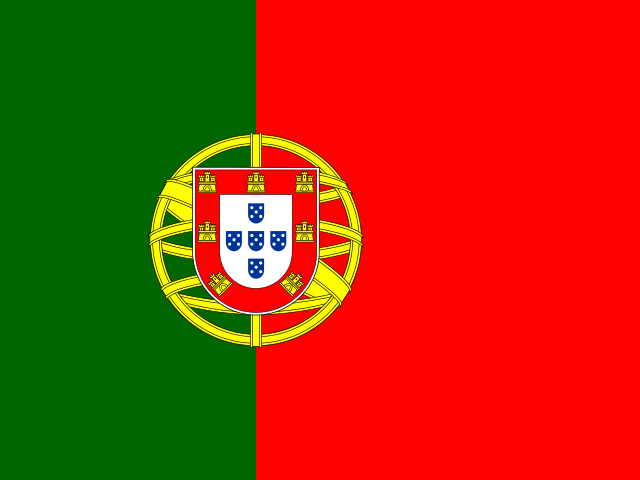
- The armillary sphere on the Portuguese flag is a navigator's instrument, a skeleton model of the heavens once used to work out where you were at sea.
- Azulejo has nothing to do with azul, blue — the word goes back to the Arabic az-zulayj, polished stone. São Bento station in Porto has around twenty thousand of the tiles lining its entrance hall.
- The Joanina Library in Coimbra keeps a colony of bats behind its bookcases; they come out at night to eat the insects that would otherwise eat the books, and the tables are covered in leather each evening.
- Portuguese has a personal infinitive, an infinitive that takes endings for whoever is doing the action — a rarity among European languages, and a neat way to say in one clause what English needs two for.
- Vinho verde means green wine, but the green is its youth rather than its colour — it is bottled early, comes white, red or rosé, and often arrives with a faint prickle of fizz.
- The alliance between Portugal and England, signed at Windsor in 1386, has never lapsed and is generally described as the oldest alliance in the world still in force.
- June belongs to the Santos Populares: Lisbon fills up for Santo António on the 12th and 13th, Porto for São João on the 23rd and 24th, when strangers bop each other on the head with squeaky plastic hammers.
- Bacalhau, the salt cod at the centre of Portuguese cooking, never swims anywhere near Portugal: it is caught in cold northern waters, salted, dried hard as a board, and soaked back to life at home.
- The caravel, a small ship rigged with triangular lateen sails, could sail far closer to the wind than earlier vessels, which meant crews working their way down the African coast could also get home again.
- In Furnas on São Miguel, cozido is lowered into the volcanic ground beside the lake in a sack and left for hours to cook on the earth's own heat before being dug up for lunch.
- A francesinha in Porto is a sandwich buried under melted cheese and a hot beer-and-tomato sauce, usually with a fried egg on top and chips banked up around the plate.
- The Portuguese Water Dog was bred along the Algarve coast to work from fishing boats, driving fish towards the nets, retrieving gear that went overboard and carrying messages between crews.
- Bertrand, in Lisbon's Chiado, has been selling books since 1732 and is recognised as the oldest bookshop still trading anywhere in the world.
- The Douro valley was marked out as a protected wine region in 1756, one of the earliest anywhere, and its vineyards climb the slate slopes in terraces cut and stacked by hand.
- Marmalade is a Portuguese word. Marmelada meant quince paste, from marmelo, a quince, and English kept the name after quietly switching the fruit to oranges.
- The rooster on every souvenir shelf is the Galo de Barcelos, from a folk tale in which a roasted cockerel stands up on the platter and crows to prove a traveller innocent.
- Fado takes its name from fatum, Latin for fate. Lisbon fado is sung in small bars by singers of either sex; Coimbra fado belongs to the university, is sung by men, and is applauded by coughing.
- Portugal's convent sweets run on egg yolks: ovos moles from Aveiro are yolk and sugar piped into thin wafer shells shaped like fish, barrels and scallops, and eaten in a single mouthful.
- Ginjinha is a sour-cherry liqueur poured in tiny glasses at hole-in-the-wall counters in Lisbon and Óbidos, where it is sometimes served in a small cup of chocolate you eat afterwards.
- Fernando Pessoa wrote under dozens of invented identities he called heteronyms, giving each one a biography, a horoscope, a style and firm opinions, then letting them argue with each other in print.
- Desenrascanço is the knack of wriggling out of a fix with whatever happens to be lying around: not planning and not luck, but improvised escape, and the Portuguese count it a national skill.
- Portugal's mainland borders have barely shifted since they were fixed by treaty in 1297, which makes them among the oldest settled frontiers in Europe.
- The Portuguese man o' war is named after a ship: sailors thought the float riding above the water looked like a caravel under sail, and in Portuguese it is still a caravela-portuguesa.
- Piri-piri chicken takes its name from pilipili, a Swahili word for pepper, carried along Portuguese trade routes with the small fierce chilli itself; the bird is split flat, grilled and brushed with chilli, garlic and oil.
- Fernão de Magalhães, born in Portugal and known in English as Magellan, planned and led the voyage that first went right around the world, though he sailed under the Spanish flag and did not live to finish it.
- Cobra is simply the Portuguese word for snake; English took it from cobra de capelo, hooded snake, the name sailors brought home after meeting one in India.
- Portuguese traders reached Japan in the 1540s and left words behind: Japanese pan for bread comes from pão, tabako from tabaco, and the sponge cake castella from a Portuguese sweet.
- English says tea and Portuguese says chá because the word arrived by different roads: Portuguese traders picked theirs up at Macau, where the Chinese word was chá, while other Europeans bought through ports that said te.
- When Portugal shut its monasteries in 1834, the pastel de nata recipe passed from Jerónimos to a sugar refinery next door; the shop that began baking them there in 1837 is still turning them out.
- Catherine of Braganza carried her Portuguese tea habit to London when she married Charles II in 1662, and the fashion for drinking it took hold at court and spread from there.
- Algarve comes from the Arabic al-Gharb, meaning the west — the name for the western edge of Al-Andalus, which the region kept long after the language moved on.
- The guitarra portuguesa is pear-shaped, strung with twelve steel strings in six pairs and tuned by a fan of screws at the head; its shimmering ring is the sound behind a fado singer.
- The University of Coimbra has been teaching since 1290, and its students still turn out in long black capes worn over ordinary clothes.
- K, W and Y sat outside the Portuguese alphabet for most of its history, kept only for foreign names, until the spelling agreement signed in 1990 formally let them back in.
- Portuguese pavements are mosaics: calceteiros hammer small blocks of white limestone and black basalt into sand by hand, which is how Lisbon's Rossio ended up with a rolling wave underfoot.
- Portugal keeps the same clock as Britain and Ireland rather than the rest of continental Europe, which is why an evening in Lisbon runs an hour behind the same evening in Madrid.
- The Ria Formosa in the Algarve is a lagoon shielded from the ocean by shifting sand islands, a nursery for clams, wading birds and seahorses, and reached by ferry rather than by road.
- Port ages across the river from Porto, in the cool lodges of Vila Nova de Gaia; the wine once came down the Douro in flat-bottomed boats called barcos rabelos, a few of which still sit moored at the quay.
- The country is named after a harbour: Portus Cale, the Roman-era port at the mouth of the Douro, gave its name to the county of Portucale and eventually to both Portugal and Porto.
- Portugal has a second official language: Mirandese, spoken in a handful of villages around Miranda do Douro up near the border, and formally recognised by law in 1999.
- A cataplana is a hinged copper clam-shell pan from the Algarve that seals shut and steams shellfish in their own juices; the dish that comes out is named after the pan it cooked in.
- Obrigado changes with the speaker rather than the person being thanked: a man says obrigado and a woman says obrigada, because the word literally means I am obliged.
- Saudade names the ache of missing something you love and may never have again — a person, a place, a time — and Portuguese treats it as a feeling worth keeping rather than curing.
- The Azores are nine volcanic islands roughly a third of the way across the Atlantic, sitting where three tectonic plates meet; the name is traditionally traced to açor, the Portuguese word for goshawk.
- The tilde in não, pão and coração marks a nasal vowel, sounded partly down the nose, and it is the sound most travellers notice first about spoken Portuguese.
- Mainland Portugal tops out at Torre in the Serra da Estrela, 1,993 metres up, but the country's real summit is Pico, a volcano in the Azores that reaches 2,351 metres.
- Christmas Eve dinner, the consoada, is not a roast at all: it is boiled salt cod with potatoes, cabbage and egg, dressed with good olive oil, and the feasting proper waits until the next day.
- Cabo da Roca, a wind-scoured headland west of Sintra, is the westernmost point of mainland Europe; the stone marker there quotes Camões on where the land ends and the sea begins.
- Queijo Serra da Estrela is curdled with thistle flower instead of animal rennet, which leaves it so soft that the traditional way to serve it is to slice off the top and spoon the cheese out.
- Madeira wine is deliberately cooked: barrels shipped as ballast through the tropics came back tasting better for the heat, so producers now warm the wine on purpose, and an opened bottle keeps for months rather than days.
Test the four channels.
Understanding Portuguese by ear, reading, recall, and your own mouth. Quick rounds — do them twice.